East Anglian Rivalries: A History Through Yellow And Green Spectacles
It isn't just football where Norwich comes out on top. Cameron Huggett takes us on a historical journey to comprehensively and objectively prove that the fine city is the pride of Anglia.
The East Anglian derby is a special fixture in English football. Rather than a cross-city or cross-county clash, this rivalry instead sees a region split in two. Sleepy and isolated as East Anglia is, the derby is often deeply misunderstood by fans of other clubs. It is not simply a convenient match, whereby a couple of somewhat-nearby teams sought out to manufacture a rivalry to spice up the fixture calendar. As Jonathan Liew would write in The Irish Independent in 2014: ‘The very isolation of the ‘Old Farm’ derby is its great asset: the sense that in this fenland universe, these are not football teams, but empires, and the only two empires that matter.’
The actual origins of the animosity between Norfolk and Suffolk have been somewhat lost to the mists of time. All we really know is that, at some point in the centuries after the Romans left Britain, the people of the flatlands east of the fens separated themselves into the ‘North Folk’ and the ‘South Folk’, with the river Waveney acting as a rough dividing line. In fact, this split may actually predate the founding of the Kingdom of East Anglia in the sixth century. This must surely mean that the supposed roots of the East Anglian derby stretch back further than most other footballing rivalries.
Whilst Ipswich was once a major port (with south-eastern Suffolk being the heartlands of the ruling Wuffingas dynasty), its importance had declined sharply by end the Anglo-Saxon period. Norwich, meanwhile, would establish itself as a centre of trade, culture, and religion, helped along by Scandinavian influence, and the Normans constructing a magnificent cathedral and royal castle. Not only did it emerge as the indisputable capital of the region, but its wealth and size meant it could claim the title of England’s second city until the industrial revolution sparked into life. Today, it is the best place to live in the UK (not my words, Carol, the words of the Sunday Times).
Since the first meeting of Norwich and Ipswich in 1902 (won by Norwich), the rivalry has had a dramatic history. According to the historian Richard Mills, Ipswich applied for election to the football league in the 1930s, in part, due to a significant chunk of the town’s football fans (perhaps up to 2,500 people) being uninterested in the poor standard of their local club and instead habitually taking the train to watch Norwich, a well-established professional outfit. The two sides first met in the football league on the very eve of the Second World War.
Notable incidents since the end of the war include: Norwich preventing Ipswich from completing a domestic double by knocking them out of the FA in 1962, Norwich beating Ipswich in the Milk cup semi-final in 1985 before lifting the trophy at Wembley, and Norwich having a sixteen year unbeaten run which included: a playoff semi-final win, a 1-5 away win, a 4-1 home win, a last minute equaliser that left Town crestfallen, ‘city going up and the scum going down’, and a win and a draw in a season where Ipswich missed out on the league title by two points. Ipswich may also have won some matches occasionally. (If you want to take a deeper dive into past derby matches, Spud Thornhill has written a fantastic article for ACN on the subject).
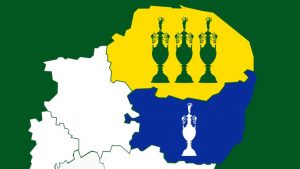
However, the rivalry between the two counties’ association football clubs is just one manifestation of the rivalry between the two counties. Before the codification of football in the nineteenth century, a folk form of the game called ‘the camping game’ was popular in East Anglia from the medieval era. A match in the 1740s between Norfolk and Suffolk on Diss Common (lasting 14 hours) supposedly had 300 a side and left nine people dead.
Other inter-county sporting clashes have been more genteel. Representative sides from Norfolk and Suffolk have contested each other in cricket since their first meeting in 1764 in Bury St Edmunds (with Norfolk coming away the victors). Rowing was another arena for competition, with the Deuchar cup being contested annually between 1909 and the 1950s. Today, the rivalry plays out in virtually every sport the two counties compete in: from Motorcycle Speedway (Kings Lynn Stars and Ipswich Witches), to American Football (Norwich Devils and Ipswich Cardinals, with Norwich defeating Ipswich to secure the National Championship in 1989), and Rugby Union (including through the extremely on-brand annual Young Farmers match; as well as the Tri-Counties cup, contested between Norfolk, Suffolk, and Cambridgeshire).
Despite all this, perhaps the two halves of the East Anglian divide have more in common than we care to admit? Yes, Ipswich fans see Norwich as isolated and backward (not that we mind), and Norwich fans see Ipswich as little more than a London commuter town, but we are defined and bound together by our similarities as much as our differences. Both clubs proudly reflect their respective counties (and by extension their connection to the region). Nowhere is this connection more evident than in their crests: the Suffolk Punch for Ipswich, and the Norwich canary introduced by the Flemish and Walloon refugees who helped shape the local textile and printing industries, alongside the lion and castle of the city coat of arms.
Ultimately, isn’t this what the derby is all about? Who represents East Anglia better?
The answer: Norwich, obviously.
Sources:
Michael Bailey, ‘Derby Days East Anglia: Ipswich Town vs Norwich City’, The Athletic, 19 December 2023.
Jeremy Black, A Short History of Britain 2nd Edn. (London: Bloomsbury, 2015).
David Boulton, Viking Migration and Settlement in East Anglia: The Place-Name Evidence (Oxford: Windgather Press, 2023)
Chris Hill, ‘Norfolk Young Farmers Win Rugby Match Against Suffolk YFC’, Eastern Daily Press, 28 March 2025.
Derek James, ‘Derek James Explores the History of Cricket in Norfolk’, Eastern Daily Press, 28 February 2026.
Christopher Joby, ‘Canaries and Weavers: The Flemish Strangers in Norwich’, The Low Countries, 29 April 2019.
Andrew Lawn, We Lose Every Week (Huddersfield: Ockley Books, 2020).
Jonathan Liew, ’20 of the Fiercest Rivalries in English Football’, Irish Independent, 31 October 2014).
Richard Mills, ‘An Exception in War and Peace: Ipswich Town Football Club, c.1907-1945’, Sport in History 36:2 (2016), pp.214–241.
Peter Mann, ‘Britball: We Meet Norwich Devils’ Stuart Theobald’, The Touchdown, 21 April 2024.
Geraldine Scott, ‘East Anglian Derby Not the Only Rivalry Between Norfolk and Suffolk, as the Two Counties Took to the Water for Historic Deuchar Cup’, Eastern Daly Press, 26 February 2017.
Owen Sennitt, ‘Norfolk’s Murderous Diss Football Game that Left Nine Dead’, Diss Mercury, 10 June 2023.
Barbara York, Kings and Kingdoms of Early Anglo-Saxon England (London: Routledge, 1997)
‘England’s Second City’, Museum of Norwich
‘History’, Suffolk Cricket.
‘Ipswich: A Historical Town and Port’, Suffolk Heritage Explorer
‘Men’s Tri Counties Cup 2024/2025’, Norfolk RFU.
‘Norwich, Norfolk, Named Best Place to Live in the UK 2026’, Sunday Times, 20 March 2026.
‘Wuffingas Dynasty – The Wolf Kings of East Anglia’, Anglo-Saxon Heritage, 13 March 2024.
Parma Nodge Badge *SALE PRICE*
Bologna Nodge badge - *SALE PRICE*
Napoli Nodge Badge *SALE PRICE*
Comments
There are no comments on this article yet.
The ACN Podcast - Episode 164
08/04/26
Jon, Clare & Tom reflect on a bountiful bank holiday Monday at Millwall, a difficult draw against Pompey and the small matter of a local derby at the weekend.....
Leave a Reply